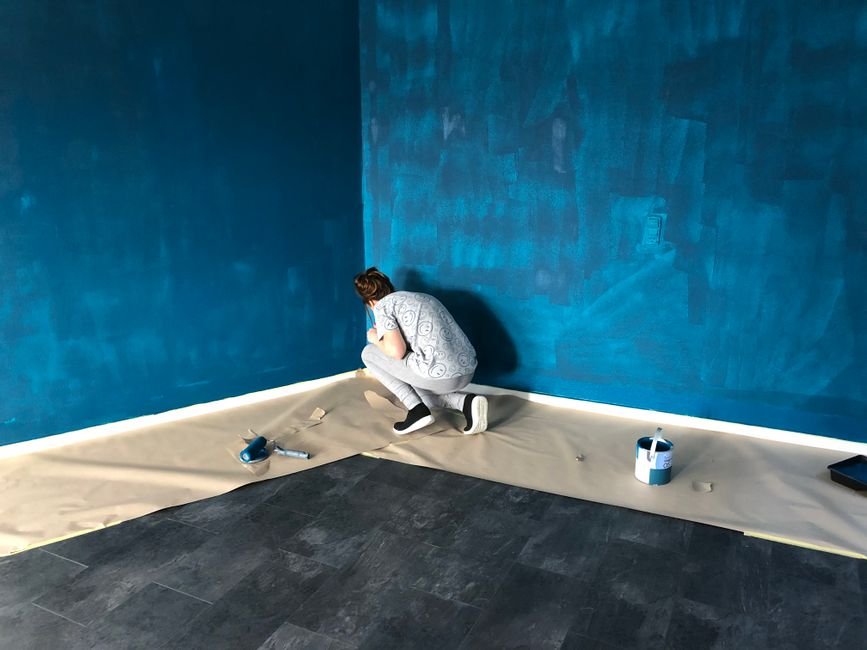
The quick answer: a typical gallon of paint covers about 350 to 400 square feet, so a 10×10 room with 8-foot ceilings usually needs just one gallon. But the real answer depends on a few things: your wall dimensions, how many coats you’re planning, primer needs, and the condition of your walls.
Let’s walk through how to figure out exactly how much paint you need before you start your project.
Related: How Much Does It Cost to Paint a Bedroom in 2026
Step 1: Measure Your Wall Surface Area
Start with a tape measure. You need the height and width of every wall you plan to paint.
Here’s the math:
- Measure the length of each wall
- Measure the height from floor to ceiling
- Multiply length x height for each wall
- Add all four walls together
Example: A room that’s 12 feet wide, 14 feet long, and 8 feet tall.
- Two walls: 12 x 8 = 96 square feet each (192 total)
- Two walls: 14 x 8 = 112 square feet each (224 total)
- Total wall area: 416 square feet
Don’t include doors and windows in your measurement (most people skip this anyway, and it balances out the trim you might paint). Keep it simple.
Step 2: Check Your Paint’s Coverage Rate
Every paint can has a coverage rate on the label. It usually says something like “350 square feet per gallon” or “covers up to 400 sq ft/gal.”
Most standard interior and exterior paints fall between 300 and 400 square feet per gallon. If you don’t have the paint yet, 350 square feet per gallon is a safe baseline.
Related: How Much Does It Cost to Paint a House Interior in 2026?
Related: How Much Does It Cost to Paint a House Exterior in 2026?
If your paint is thicker, has special finishes, or is a bold color, coverage might be lower. Check the label or ask when you buy.
Step 3: Do the Division
Take your total wall area and divide it by the coverage rate.
Total wall area / coverage rate = gallons needed
Using our example: 416 square feet / 350 sq ft per gallon = 1.19 gallons. So you’d need at least 1.5 to 2 gallons to be safe.
Always round up. It’s better to have a little left over than to run short mid-project.
Step 4: Add Primer (If You Need It)

Primer is not always necessary, but it covers less area than paint. Primer typically covers 200 to 300 square feet per gallon.
You should prime if:
- The walls have never been painted
- You’re painting over a dark color with a light one
- There are stains, marks, or water damage
- The walls are glossy or slick
Calculate primer the same way: divide your wall area by 200 square feet per gallon. In our example, 416 / 200 = 2.08 gallons of primer.
If you’re only spot-priming problem areas, you might only need half a gallon or a quart.
Step 5: Account for Multiple Coats
One coat of paint rarely looks finished. Most rooms need two coats, especially if you’re going lighter or changing colors dramatically.
If your calculation shows you need 2 gallons for one coat, plan for 4 gallons for two coats.
A professional painter knows that good prep work and quality paint can sometimes get away with one coat on repaints, but a second coat gives you better coverage, richer color, and longer-lasting results.
What Affects How Much Paint You Actually Need
A few things can throw off your estimate:
- Wall texture: Textured or popcorn walls soak up more paint than smooth drywall. You might need 10-20% more.
- Paint quality: Premium paints often have better coverage than budget brands, so they may go further.
- Surface prep: Dirty, glossy, or damaged walls need extra primer or sanding, which means more material overall.
- Color choice: Bold reds, yellows, and dark colors can require an extra coat or two to avoid streaking.
- Ceiling height: Tall ceilings increase wall area. Measure carefully.
If you’re unsure about any of these factors, it’s smart to buy a little extra. Leftover paint in a sealed can keeps for years, and matching a color later is a headache.
A Practical Example for Different Room Sizes

Here’s what a typical single-coat estimate looks like for common rooms:
- Small bedroom (10×10, 8-foot ceiling): About 320 square feet of wall. Plan for 1 gallon of paint plus primer.
- Master bedroom (14×16, 9-foot ceiling): About 540 square feet of wall. Plan for 1.5 to 2 gallons of paint plus 2 gallons of primer.
- Kitchen (12×14, 8-foot ceiling): About 416 square feet of wall (not counting island or peninsula). Plan for 1.5 gallons of paint, maybe less if you’re only painting walls and not cabinets.
- Living room (16×18, 9-foot ceiling): About 612 square feet of wall. Plan for 2 gallons of paint plus 2 gallons of primer.
These are rough guides. Your actual needs depend on how many coats you want and whether you’re priming.
When to Call in a Professional
If you’re painting a whole house, multiple rooms, or dealing with tricky surfaces like textured walls or glossy finishes, a professional estimate is invaluable. Nu-Trend Painting Inc can measure your space, assess your walls, and tell you exactly what you need before a single drop gets mixed.
Professionals also know how to account for waste, overlaps, and the quirks of your specific space. They’ve done this thousands of times, so their estimates are spot-on.
Plus, if you’re hiring a painter anyway, you don’t have to worry about the math at all. A good contractor like Nu-Trend Painting Inc will figure out exactly how much paint is needed and factor it into the project plan.
Pro Tips Before You Buy
Talk to the staff where you buy your paint. Tell them your room size and color choice. They can often refine your estimate based on the specific paint you’re using.
If you’re painting a dark room a light color, or vice versa, mention that. They might recommend an extra coat or a primer tinted to match your paint.
Buy your primer and paint at the same time so you know everything is compatible. Some stores can even tint primer to your paint color, which saves you money and coats.
Label your cans with the room name and date. If you need a touch-up in six months, you’ll know exactly what you used.
Frequently Asked Questions
Do I need primer if I’m repainting the same color?
Not always. If the walls are in good shape and you’re using the same color, two coats of paint might be enough. But if there’s damage, stains, or a glossy finish, primer helps. When in doubt, prime the problem areas at least. It ensures better adhesion and a more uniform finish.
What if I’m painting cabinets or trim too?
Cabinets and trim need separate calculations because they’re a smaller surface area and often require primer and multiple coats. Measure the linear feet of trim or the square footage of cabinet faces and calculate separately. You might only need a quart for trim, or a quart or two for kitchen cabinets, depending on size.
Can I use leftover paint from another project?
If it’s the exact same color and finish, yes. But colors can shift slightly as paint ages or if it was mixed differently. Test a small area first. If it was thinned or has been open for months, it might not perform the same way. When in doubt, start fresh.
How much paint should I buy if I’m not sure?
Round up and buy one extra gallon or quart beyond your estimate. Sealed paint lasts years, so the extra sits in your garage until you need it. Running short in the middle of a room is much worse than having a little left over.